
Anne-Marie Mulgrew & Dancers Company
LDHP: Describe what influenced your work, who did you influence. Did you work individually, collectively, collaboratively?
It all began with me studying anthropology at Temple. Then, I stumbled upon an improvisation dance class in the 70’s and was hooked. My early training included Temple Dance Department’s founders – Fran, Sarah, Edrie, Hellmut and later Ann, John and Eva; dance studio classes in Modern (Horton) with Joan Kerr; Ballet with Thomas Cannon and Marion Tonner; Luigi based Jazz with Joanna; Improvisation with Group Motion at Philadelphia College of Art; master classes in modern techniques sponsored by Philadelphia Dance Alliance; and classes and workshops in New York City. I was captivated by dance history and quickly realized as a beginner the need to gain a greater understanding of the dance world. My written assignments for Fran’s Undergraduate Dance History classes explored the Hopi Indian Culture and the legendary Anna Halprin’s environmental work. In moving to old city with my partner/husband John and sister Eileen, we were part of the boundary busting multi-dimensional, anything is possible old city artists community. Terry Fox and Jeff Cain held free classes/improv jams with live music in their Bread Street Studio. This led to me performing in their experimental postmodern works for traditional and non-traditional spaces. Another influence was dancing with Jacqui Blatt’s Karentius Company. Jacqui collaborated with Relache musicians and dancers who worked collectively in creating amazing group lifts.
Performances that impacted me were the original Gruppe Motion Dance Theatre, The Living Theater with Julian Beck, Spalding Gray (I think with the Performance Group) in a work set in the Jewish Y on Pine Street, Dance Series at the Walnut Street Theater (where I first saw Merce Cunningham, Pilobolus, Erick Hawkins, Bella Lewitzky, Murray Louis, Ailey, Garth Fagan and others, and Annenberg Center (where I remember Twyla Tharp dancing in her Fugue, Dance Theater of Harlem, and the irascible Grand Union with Douglas Dunn wrapped in bandages and David Gordon talking where ½ the audience left. An eye opener for me was the Wear White at Night Festival in old city (possibly a precursor to the FRINGE) where artists of all kinds explored every nook and cranny from the sidewalks to rooftops to alleyways. I danced in cardboard boxes, swung from church gates, and even created an installation on our loft space deck titled, “Home” featuring a rocking chair, TV, and lamp.
In 1981 I auditioned and was accepted into Temple’s MFA dance program to develop my choreographic voice resulting in works such as Racing 1982 that was selected for the American College Dance Festival, and 30 Second Dances a sly comment on Doris Humphrey’s notion that “most dances are too long.” My MFA thesis was choreographing and performing in two shared concerts in 1981-82. In 1985, I received a scholarship from Michael Pedretti, founder of Movement Theater International, to attend his summer Clown, Mime, and Movement Theater intensive, taught by several internationally recognized artists. This experience led to the inclusion of theatrical elements in my first self-produced full-length production, Hard Facts and Stuffed Gardenias, a dance and visual event created in collaboration with Susan Sapareto (Temple Tyler School graduate). Susan created a movable set of eight-by-eight feet plywood pencil drawings of eight working people for the centerpiece work “Facing 9-5.” This large-scale concert at Group Motion Multi-Media Dance Theater on September 13-14, 1986 marked the founding of my company.
I love collaborating. As a creative team, we experience unknown terrain filled with risks, fears, rewards, and challenges. AMM & DCO has collaborated with composer Peter Price (1987-1999) and installation artist Vida -Vida (1994-99), painter Mitchell Gillette and composer Claude White (1989-1993), poet Alexandria Grilikhes and fiber artist Lucretia Robbins (1987), video artist Carmella Vassor-Johnson (2000-2014 & 2019), video artist Francesca Costanzo (2022-25) composer Andy Thierauf (2022 & 2025) and others.
LDHP: Were there issues that you addressed in your work, socio-political atmosphere of the time, antiwar movement, nature/environmental, spiritual, other -“isms” activism, feminism.
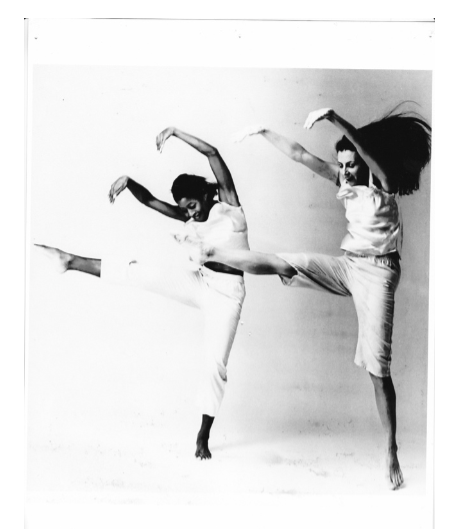
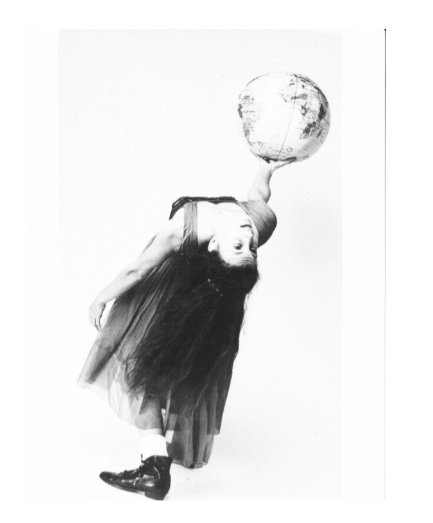
As an artist, my primary concern is the human condition and the world we live in. Hard Facts (1986) dealt with highly charged emotions filled with urgency and immediacy in navigating the real world as an artist/human. The Human Statistic (1987-88) examined environment issues mostly caused by humans. Earth Planet Dances (1987), Earthborne (1993), The Lemon Lady (2003), and Salt (2008-2010) addressed nature and the power of healing. From The Feminine Gaze celebrated the 100th anniversary of the signing of 19 th Amendment whereas Paper Waitress (2000) was a comment on gender. Dig/The Keepers Project (2012-13) investigated my family history- arriving as immigrants to a new land and the second generation dealing with war. Recent works such as Beautiful Chaos (2022) and NOW! (2023) dealt with COVID and its impact on us. A Shout from the Bones (2024) was a call to end the violence and heal. Whimsical works such as Inflatable Dreams (2019), Excerpts from The Yard (2001), Le Dada Va Gaga dans 2011 and Improvisation for the Future (2025) allow us to dream.
LDHP: What of forms?
In creating works, there are no defined forms, just an empty space and one’s imagination. My works are an amalgamation of my many influences and reactions to the times. Often works begin with an idea, sensation, image, music, literature, or a personal moment. My work incorporates elements of pure dance, theater, improvisation, music, sound, multi-media, and technology. The movement vocabulary is developed for individual works and is informed by performers backgrounds and input and basic conceit for the piece.
The Company was formed as an association and became a non-profit in the 1990’s. Rehearsals begin with a check-in session, followed by a short warm-up technique class, moving into choreographed phrases, tasks, challenges, or improvisations.
AMM & DCO sees itself as an evolving contemporary experimental dance company open to new ideas, structures, and content. Our mission is to educate and involve the public in the performance of new interdisciplinary works through performances, classes, workshops, residences, and special projects.
LDHP: Where were places you worked/performed?
In the 1980’s, AMM & DCO was presented by Conwell Dance Theater Temple Alumni Concert and two MFA shared concerts, The Painted Bride (The Joan Kerr Memorial Concert, Collab 3, Dance Days at the Bride), The Philadelphia Music of Art, Super Sunday on the Parkway, Community College of Philadelphia, Penn State Abington Campus, Group Motion Multimedia
Dance Theater (Spiel Uhr Series and self-produced two concerts Hard Facts and Human Statistic, and CEC (Performance in an Intimate Space) and in New York City at The Robert Yohn Studio.
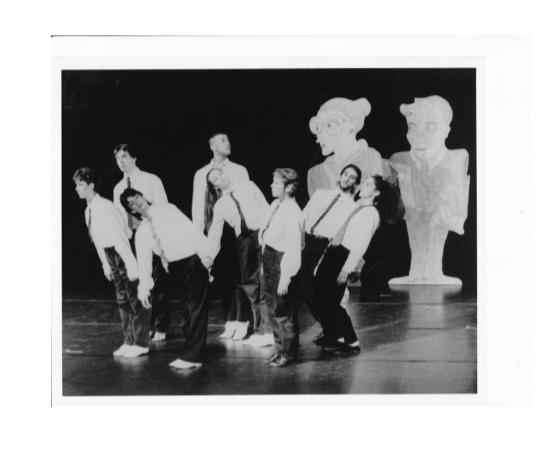
In 1990, we shared a concert with Brigitta Hermann called Two Women Two Worlds. We premiered the stage version of Tales of the Buffoon created in collaboration with Mitchell Taylor Gillette (painter, designer, project brainchild) and Claude White (composer) with subsequent performances at Nexus Gallery and Group Motion. Other major works by this team included Mouth featuring three women in Victorian paper dresses constructed by Mitch and Roadblock using six PVC pipes as props. The Tales found its home in a film version directed by Glenn Holsten produced by WHYY and funded by PEW that toured nationally as part of the Philadelphia Performs Series. The 90’s were a fertile time, AMM & DCO collaborated with Peter Price and Vida Vida in Flatland Part 1-2, Unknown City, Project 2012, and Strange Tongues the site work created for Parallax Picture Studios. AMM & DCO appeared twice at the fFIDA Festival in Toronto Canada, in New York City at DanceSpace, Ubu Repertory Theater, DIA Center, University Settlement House, and in Philly several productions at The Painted Bride, Group Motion and UARTS Drake Theater, as well as Philadelphia Museum of Art, Rodin Museum (in a commission by the Friends), Penn Museum, Transit Dances in subways, airports and galleries, and others.
In the 90’s I was also invited to be part of Martha Myers Choreolab and The Carlisle Project’s New Impulse Choreography Project – both held at UARTS. From 1993-2018, to sustain my dance making passion, I held a half-time position as Director of Education and Special Projects for Dance Affiliates/NextMove Dance under the direction of Randy Swartz.
Still active on the dance scene, approaching our 40th Season, AMM & DCO has a repertoire of more than 90 works (https://annemariemulgrewdancersco.org/) that have appeared on traditional and non-traditional spaces and in films and festivals in the US and Canada.
LDHP: What was going on at the time? The prevailing zeitgeist?
In the 1980’s, dance was popular with people of all ages taking classes in different genres possibly inspired by the MTV phenomena. The media was supportive of dance. AMM & DCO received reviews in The Welcomat, City Paper, and The Philadelphia Inquirer (who had several dance critics) as well as featured stories in Philadelphia Magazine, the Philadelphia Daily News, and Temple News. Jazz Dance Center opened offering several classes a day patterned after New York studios. The aerobic dance movement was still strong with folks flocking to classes. Hip hop was rearing its head. Breakdancing was in full throttle. PA Ballet was still in Fairmount with different teachers renting studio space for classes. Susan Hess was a hub for selected modern choreographers/companies. The Wilma Theater was on the ground floor at 2030 Sansom sharing the building with Susan Hess and Jazz Dance Center. Dance Companies/Artists included PA Ballet, Philadanco, Waves (from Jazz Dance Center), Group Motion, Joan Kerr Dance Company, Zero Moving Company, Ann Vachon Dance Conduit, Sybil, DanceTeller, South Street Dance Company, Karen Bamonte Dance, Steve Krieckaus, Terry Beck Dance, Melanie Stewart Dance, Great Chazy, Seminole Works, Volosky, Philadelphia Civic Ballet, Julia Lopez Flamenco Ole, Arthur Hall, Kulu Mele, Gwen Bye DanceFusion, AMM & DCO and others. Pew Charitable Trust and the William Penn Foundation were big supporters of the more established cultural organizations.
There were opportunities to perform in Group Motion’s Spiel Uhr Series and CEC’s Performance in an Intimate Space. The Painted Bride was a hub for presenting local and touring dance companies. Annenberg Center, The Academy of Music, Walnut Street Theater, Mann Music Center, and the Jewish Y at Pine Street presented top tier touring companies.
AMM & DCO was an emerging troupe grateful for any opportunity to show and see work and be covered by the media.
LDHP: Other thoughts?
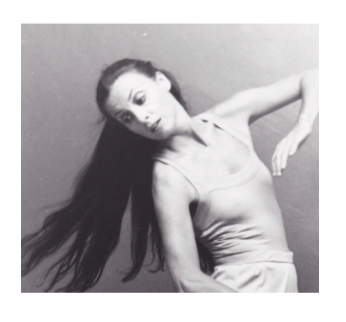
In reflecting on the past 40 years, what is important to the Company’s sustainability is nurturing long-term relationships. We cultivate meaningful partnerships with artists/collaborators/dancers, presenters, donors, funders, the media, educational and arts organizations and the dance/art community. Our history empowers us to survive in a fickle art marketplace. For instance, AMM & DCO was presented five times in the early Live Arts Fringe and self-produced five times. It was as if AMM & DCO was returning to its early roots in old city. We performed at 10 consecutive Dance Days at The Bride and rehearsed and taught at UCAL for 30 years.
In the 1980’s, the internet was just emerging. By the 90’s 42% of us used a computer. Technology has changed drastically on how artists work, see work, and share and promote their work. Technology affects us daily as to how to navigate the time-consuming changes, costs, and demands. Many of AMM & DCO’s works are on video cassettes and DVD’s, making accessibility difficult and archiving challenging.
This is the place to send gratitude to my friend, colleague, dancer, fearless collaborator, and video artist Carmella Vassor-Johnson. Carmella saw an AMM & DCO audition notice at Jazz Dance Center and joined the troupe as a dancer in The Human Statistic, Earth Planet Dances and Roadblock. Our choreographer-video collaboration spanned 15 years. Highlights included a monthlong Yard Residency 2001 (Martha’s Vineyard Chilmark MA), Choreography for the Screen Program at the School of Jacob’s Pillow 2003 and two Professional Development Opportunity Grants through PEW – one with Victoria Marks in LA, the other at the Dance for Camera Conference at the University of Utah. These opportunities informed works such as Excerpts from the Yard 2001, The Lemon Lady 2003, Three Ladies in Waiting (2004), Salt (2008- 2010), Le Dada (2011), Dig/The Keepers Project (2012-13) as well as stand-alone Dance for Camera projects – Citrus Limon, The Kitchen Dance, Links, Frances, These Women, and numerous unreleased experiments. Carmella was unstoppable, documenting performances, assisting technical issues, and bringing her magic to the Company.
Thinking back, it was a pleasure to work with Brazilian installation artist Jonas dos Santos, Woofy Bubbles, (AKA Christopher Hodges) and Japanese wood sculptor Eiko Fan.
I am so grateful to all my teachers, dancers, collaborators, board members, dance writers, supporters, colleagues, and presenters for their encouragement and support over forty years.